The Thumb Tax: Why Mobile Loop Games Still Feel Like Ports From Somewhere Else
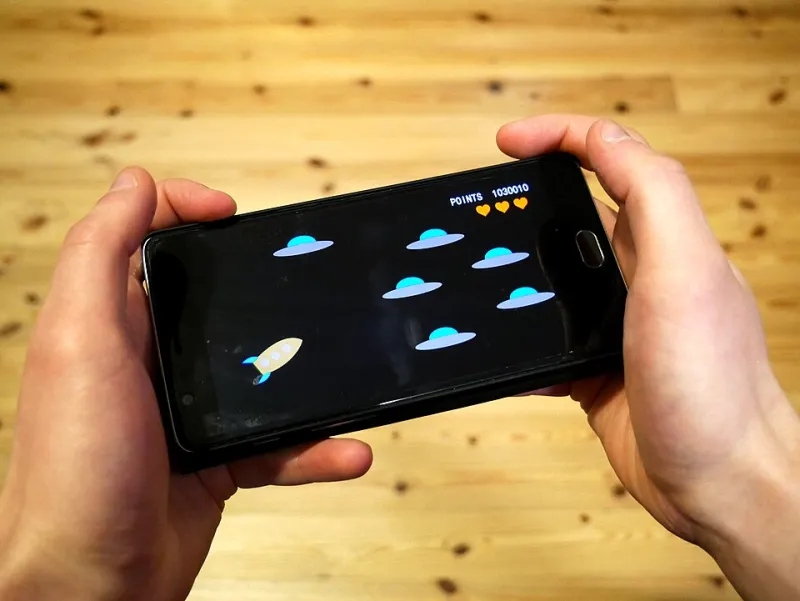
Photo: Santeri Viinamäki, CC BY-SA 4.0, via Wikimedia Commons
I have lost more loop runs to my own palm than to any boss, timer, or difficulty spike. That's not a skill issue. That's a design issue wearing a skill-issue costume.
Mobile loop games are the most natural fit for this whole genre. Short runs, instant restarts, one number to beat — it's a format practically begging to live in your pocket. And yet so many of them feel like a desktop game that got squeezed through a phone-shaped hole and never quite recovered.
The half-second handshake nobody mentions
There is a delay between your thumb moving and the game noticing. On glass, it's small — often too small to name — but loop gameplay is exactly the kind of thing that magnifies small delays into big feelings. You tap, the loop reacts a beat later, and your brain files it under I'm getting worse at this instead of the input pipeline is slow.
A mouse click gives you a physical click. A key gives you travel and a stop. Glass gives you nothing but a soft vibration if you're lucky. So the game has to work harder to confirm that it heard you, and most of them don't bother.
The fix isn't exotic. It's tightening input handling so an early tap inside a reasonable window still counts, and adding confirmation you can feel — a haptic tick on a successful loop, a short audio blip that lands on the frame your input registers instead of the frame the animation finishes. Confirmation is cheap. Silence is expensive.
One hand, zero forgiveness
People play loop games on trains, in line at the pharmacy, in bed at 11:40 p.m. with one hand and about 60 percent attention. That is not a lesser way to play. That's the default way to play, and it's the way most of these games were never tested.
Look at where a thumb naturally rests and where the buttons actually are. Then look at how much of the screen is dead space nobody can reach without regripping. Then look at the failure state: one accidental edge tap and the run is over, the streak breaks, the coffee line moves, and the session ends on a bad taste.
Accidental taps are the single most common frustration I hear from casual loop players, and the response is usually be more careful. That's not advice, that's a shrug. A game that can't tell the difference between a deliberate input and a palm brushing the glass has decided to outsource its own job to the player.
The leaderboard doesn't know you're on a bus
Here's the part that actually makes people put the phone down. The board doesn't care what you're playing on. Your 42-second run against someone on a 144Hz monitor, a mechanical keyboard, and a chair with lumbar support is treated as an identical test of skill.
It isn't. Precision input, refresh rate, screen size, and whether your thumb is free are all part of the clock, whether or not anyone admits it. When a mobile player's best run gets ranked against desktop times in one undifferentiated list, the message lands as you are slower, not you are running this on a different machine.
The honest version is boring and easy: separate boards by input type, or show the input method on the row. Nobody is insulted by a mobile board. Plenty of people are insulted by being quietly measured against hardware they don't have.
Stop calling it player error
There's a certain kind of mobile design that treats every missed run as a personal failing, and it shows up in the copy. So close! Try again! Almost had it! All cheer, all pointing at you.
If a tap target is eight pixels wide with a cooldown window shorter than a human blink, the run didn't fail. The interface did. Loop games are built on the promise that failure is fast and cheap, so you'll go again. That promise evaporates the moment failing feels arbitrary instead of instructive.
What a phone-first loop game looks like
I don't want a stripped-down port. I want the opposite — a game that assumes the phone is the best possible place for this.
That means big, tolerant tap zones anchored in the thumb arc. It means the whole screen is a button where it can be. It means forgiving the first input after a pause, because you were clearly checking a text. It means latency-balanced timing windows rather than raw milliseconds. It means haptics that tell you the loop registered before your eyes catch up. It means a board that knows your device and says so.
None of this is technically radical. It's just uncommon, because so many teams still build the desktop version first and treat the phone as a delivery mechanism for the leaderboard.
The bar is on the floor
The competition isn't a rival loop game. It's the podcast you could be listening to instead. One clumsy run and you're back to audio. One that wasn't my fault and you're gone for a week.
Mobile players aren't the casual tier of the genre. They're most of it. Build like you know that and the loops get tighter, the boards get fairer, and my palm stops costing me runs.